
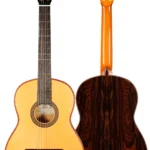
How to Choose the Right Guitar for You
At Mundo Luthier, we select brands and models for their genuine quality and musicality, not for trends. A rigorous catalog for the discerning guitarist.
Table of contents
Choosing the right guitar is not about picking a trendy brand or focusing on a single detail. It comes down to two sensible decisions:
1- Choosing the right family (classical, flamenco, or acoustic)
2- Refining the character of the instrument (tonewoods, response, and sound) so it fits you and what you plan to play.
1. Choose the Right Guitar Family.
Think of this as choosing the instrument’s foundation. It is not just about string type: it changes the response, attack, projection, and the feel when playing.
Classical guitar
Choose a classical guitar if you are looking for a balanced sound with a great capacity for nuance and control. It is usually the best option if you want to study, play fingerstyle, work on articulation and dynamics, and have every note heard with clarity.
Ideal for:
- Classical and contemporary guitar music (solo or accompaniment).
- Bossa nova, bolero, samba and Latin music with fingerstyle.
- Soft acoustic pop, intimate singer-songwriter material, ballads and vocal accompaniment.
- Nylon fingerstyle, arpeggios, melody with bass and arrangements.
- Jazz on nylon strings (colored chords, soft comping, melodies).
- Anyone looking for a beautiful, controllable sound with many nuances.
Flamenco guitar
Choose a flamenco guitar if your priority is immediacy: a note that “fires” quickly, a drier character, and a very strong rhythmic and percussive dimension. It is the guitar made for compás, rasgueado, alzapúa, and clear articulation.
In flamenco there are two main families (and we stock both):
- Flamenco blanca (cypress): the traditional approach, with lots of attack, dry brightness, fast response, and a very direct feel.
- Flamenco negra (rosewood or other dense woods for the sides and back): which keeps the flamenco character but usually adds more body, more depth, and more sustain than a blanca, without losing the flamenco intention.
Ideal for:
- Traditional flamenco (accompaniment for singing and dance) and modern or solo flamenco.
- Compás and accompaniment: clean rasgueados, closures, finishes, calls and fast changes.
- Flamenco techniques: picado, alzapúa, flamenco arpeggios, ligados, flamenco tremolo and strong thumb playing.
- Anyone who wants a guitar with fast attack and immediate response with the feeling of not having to push.
- Players who use a lot of right hand and want a guitar that marks the rhythm clearly without muddying.
- Classical guitarists who want a more direct response for flamenco and greater comfort.
Acoustic guitar
Choose an acoustic guitar if you want presence, brightness, defined attack, and chords that fill the room. It is the typical instrument for singing with accompaniment, playing with a pick, broad strumming, and modern fingerstyle.
Ideal for:
- Pop, rock, folk, country, singer-songwriter music, and more.
- Open, rhythmic strumming with plenty of projection.
- Pick playing: riffs, intros, accompaniment with dynamics, from soft to loud without losing punch.
- Modern fingerstyle (melody + bass, percussive playing, alternating bass, arrangements).
- Band accompaniment
- Alternate tunings (Drop D, DADGAD, Open G, etc.) for textures and compositions.
2. Define Your Sound (This Is Where Tonewoods Matter)
Once you choose the family, the tonewoods help you refine the character. And here it is really worth paying attention: in high-end guitars, the selection and quality of the wood is not decoration; it is part of the result.
The Soundboard: The Most Decisive Point
If we had to simplify, it would be like this:
- Spruce: usually gives clarity, definition, and a natural brightness; it is especially valued when you want note separation and an open sound.
- Cedar: usually gives a warmer tone, with a sense of body and a rewarding response from the very first note; it is a popular choice if you want a round, full sound.
In acoustic guitars, beyond spruce and cedar, there are other soundboard options depending on the brand and model. The main idea is this: soundboards that lean toward clarity and attack versus soundboards that lean toward warmth and body, and above all, how the guitar is built as a whole.
Sides and Back: Body and Personality
This is where much of the character comes from:
- In classical guitars, woods like rosewood and other dense species are often associated with more depth, richness, and presence.
- In flamenco guitars, cypress defines the traditional character of the blanca; and in the negra, rosewood or other dense woods add more body and a different color without moving away from flamenco territory.
The best way to use this as a buyer:
- If you want a direct, dry sound, look toward lighter, more traditional flamenco guitars, especially a blanca.
- If you want flamenco but with more depth and a bigger feel, look at a negra.
- If you want balance and nuance, choose a well-selected classical guitar, and here the woods make a big difference in the final color.
3. Set-Up (and Why Guitars Sometimes Buzz)
The set-up is the fine-tuning that defines how the guitar feels in your hands: comfort, speed, and clarity. There is no need for technical jargon; the important thing is to understand that a more comfortable set-up usually brings the strings closer to the frets and, in some situations, light buzzing may appear.
There is also the other extreme: a higher action usually gives more room to play hard without buzzing and, in many cases, is perceived as a cleaner and more open sound, with more string vibration. In return, it usually feels harder and less comfortable, and demands more effort from the left hand, especially in barre chords and long sessions.
When Is It Normal for a Guitar to Buzz?
- Low action (strings closer to the frets): aimed at comfort and speed; in return, if you play hard, light buzzing is more likely to appear.
- Hard playing or aggressive technique: powerful strumming, a hard pick attack, heavy strumming, or picado with a lot of pressure cause the strings to vibrate with greater amplitude and touch the frets.
- Flamenco with a fast set-up: in flamenco, it is common to look for an agile feel; a controlled buzz can be part of the character as long as it does not choke the note or make the guitar uncomfortable.
- String changes (tension/gauge/brand): this changes the vibration and buzzing may appear or disappear, even though the guitar is the same.
- Climate and humidity changes: the wood moves slightly with the seasons or sudden changes, which can alter its behavior. It is recommended to maintain stable humidity, ideally with a case humidifier if the environment is very dry; and if buzzing continues or the guitar feels off after a few days, the right course of action is a setup check for that climate, which is normal with wooden instruments.
4. Real Quality (Why a “Better” Guitar Stands Out)
Usually, a higher-quality guitar is not “just a bit prettier”: you notice it in very specific ways when you play.
- Greater nuance: the instrument responds to small changes in your hands.
- Better projection: it does not just sound; it keeps the sound focused and present.
- Better balance: the bass, mids, and treble are musically balanced.
- A stronger sense of a living instrument: it gives more back and requires less effort.
This is what makes a good guitar not only sound better, but also make you want to play it more.
5. Budget (Direct, Honest, and Professional)
If you can afford it, our recommendation is simple: buy the highest-end guitar that fits you.
Why do we say it so clearly?
- Because in guitars, moving up a tier usually means better wood selection, better construction, and a fuller sound.
- Because people who buy just enough often end up wanting to upgrade sooner, and that usually costs more in the long run.
- Because a quality guitar stays with you for more years: you grow, and the instrument grows with you.
This does not mean “buying expensive for the sake of it.” It means investing in what truly matters: sound, response, and quality.
And this is where we want to be very transparent: on our website we do not carry everything. We personally choose models and brands, with the insight of guitarists and luthiers, looking for instruments that make musical sense and offer real quality.
Decision Tables (How to Choose Without Getting Lost)
1) What you are looking for → recommended guitar
| If you are looking for… | Recommendation |
| Nuance, balance, fingerstyle study, note separation | Classical |
| Immediate response, rhythm, dry attack, compás | Flamenco (white or black, depending on the tone you want) |
| Brightness, presence, big chords, singing while accompanying | Steel-string acoustic |
2) Within flamenco: white vs black
| If you want… | Choose… |
| Very direct, dry, traditional sound, very clear rhythm | White flamenco (cypress) |
| Flamenco with more body, depth and sonic weight | Black flamenco (rosewood or other dense woods) |
3) Soundboard character (quick guide)
| If you like a sound… | Usual tendency |
| Brighter, more defined, and clearer | Spruce |
| Warmer, rounder, and fuller-bodied | Cedar |
What is the best guitar for someone who is starting out or returning after years away?
The one that makes you play every day: usually a guitar with a good response and a sound you fall in love with from the first chord. If you are unsure between types, tell us what you are going to play most of the time and we will guide you.
Classical or flamenco if I want to learn flamenco “seriously”?
If your goal is flamenco, logically the flamenco guitar makes it easier by response and character. If you are starting out and already have a classical, you can also progress, but the feel is different.
White or black flamenco for accompanying singing and dance?
It depends on taste: the white tends to be very to-the-point and marks the rhythm with great clarity; the black adds more body and a different presence.
Acoustic or Spanish guitar if I want to sing with accompaniment?
If you want brightness, presence and big chords, the acoustic is usually the natural choice. If you want more intimate, rounded accompaniment with fingers, the Spanish (classical) can be perfect.
What affects sound more: tonewoods or construction?
Both. The tonewoods provide the character and the “palette”, but the construction and final setup determine how that becomes a real musical instrument. That is why it makes sense to buy from a shop that selects carefully and knows what it sells.
Spruce or cedar: which is the safe choice?
If you want clarity and definition, spruce. If you want warmth and body from the very beginning, cedar.
Can you recommend a specific guitar for me?
Yes. Write to us via the contact form and tell us: type of music, budget, whether you play with fingers or a pick, and whether you prefer a brighter or warmer sound. We will suggest specific options (and explain why) as guitarists and luthiers.