
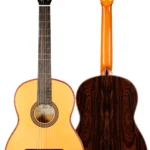
Classical, Flamenco and Acoustic Guitar Differences: A Clear Guide to Sound, Construction and Comfort
When someone searches for “classical guitar vs acoustic” or “differences between classical and flamenco”, it is easy to find answers that are too simple: “one has nylon strings and the other steel”, or “this one is for a particular style”. That is only part of the story. The real difference is a combination: string type,…
Table of contents
When someone searches for “classical guitar vs acoustic” or “differences between classical and flamenco”, it is easy to find answers that are too simple: “one has nylon strings and the other steel”, or “this one is for a particular style”. That is only part of the story.
The real difference is a combination: string type, how the vibration is transferred to the instrument (bridge and soundboard), how that vibration is controlled (bracing and internal reinforcements), standard dimensions and setup. All of this defines the character of the sound and the comfort.
What is a classical guitar
The classical guitar is designed for a balanced and controllable sound, with a great capacity for nuance. It is notable for note separation and clarity in repertoires where articulation and dynamics matter.
What is a flamenco guitar
The flamenco guitar belongs to the Spanish guitar family, but is oriented towards a more immediate response, a drier character and an important percussive dimension. Many instruments typically feature a golpeador (tap plate) and a setup that favours speed and rhythmic articulation.
What is an acoustic guitar (steel-string)
The steel-string acoustic is designed specifically for that type of string. They are generally perceived as guitars with great projection and presence, with a defined attack and characteristic brightness.
How sound is produced: soundboard and bracing (explained simply)
The string vibrates and that vibration reaches the bridge. From there, the soundboard is the part that moves most and converts that energy into audible sound.
Beneath the soundboard is the bracing (and other internal reinforcements). Its function is not just “to hold”: it also determines how the soundboard can vibrate, which areas work more and what limits that vibration has. That is why it has such an influence on:
- Attack (how the note “fires”).
- Projection (how the sound “comes out”).
- Sustain (how long it lasts).
- Balance between bass, mids and treble.
- Sense of response (more immediate or more gradual).
Important: today there are many designs
There is no single “classical bracing”, “flamenco bracing” or “acoustic bracing”. There are traditional families and many modern variations, and each builder adjusts thicknesses, stiffness and distribution in pursuit of a specific sonic goal. That is why it is better to talk about tendencies, not absolute rules.
Strings: materials and effect on the feel
Strings on classical and flamenco (not just “nylon”)
Classical and flamenco guitars use a very wide range of non-metallic materials. Among the most common are:
- Nylon (various formulations).
- Carbon fluoride (carbon).
- Nylgut-type materials and other synthetic compounds.
Changing the material and tension modifies the brightness, the feel under the fingers, the projection and the type of response.
Strings on acoustic guitars (steel)
On steel-string acoustics the strings are metallic. This greatly influences the character: more defined attack, pronounced brightness and a different sensation of tension.
Sound differences (a clear comparison)
To compare without clichés, use these five criteria: attack, projection, sustain, separation and colour.
Sound of the classical guitar
- Attack: round and malleable.
- Separation: high (voices are clearly heard).
- Colour: very wide depending on touch.
- Sustain: balanced.
- Overall impression: control, detail, nuance.
Sound of the flamenco guitar
- Attack: fast and immediate.
- Separation: clear, with a drier character.
- Colour: bright with a percussive component.
- Sustain: more contained.
- Overall impression: rhythm, immediacy, articulation.
Sound of the acoustic guitar (steel strings)
- Attack: defined and present.
- Projection: high.
- Colour: brightness and evident harmonics.
- Sustain: generous (especially in chords).
- Overall impression: presence and sonic breadth.
Dimensions and comfort: what the musician notices most
Neck width and string spacing
- Classical and flamenco guitars tend to feel more “spaced out”, which is very comfortable for clean fingerpicking.
- Many acoustics feel more compact, which many guitarists find natural for chord playing.
Action (string height) and the feeling of speed
- In flamenco a speed-oriented setup (lower action) is common, and a controlled “buzz” may appear when playing hard depending on the setup.
- In classical a balance between comfort and cleanliness is often sought.
- In acoustic the setup is done with the behaviour of steel strings in mind.
Tension feel
- Steel strings: firmer feel.
- Classical/flamenco: the feel varies greatly depending on the material and tension of the set.
Quick comparison table
| Aspect | Classical | Flamenco | Acoustic (steel strings) |
|---|---|---|---|
| Priority | Nuance and balance | Response and rhythm | Projection and presence |
| Attack | Round | Very fast | Defined |
| Sustain | Balanced | More contained | Generous |
| Colour | Very malleable | Bright/percussive | Bright/harmonic |
| Feel | Spaced | Fast | Firm and present |
What is the main difference between classical and acoustic guitar?
The acoustic uses steel strings and is designed for that behaviour (projection and defined attack). The classical uses non-metallic strings and prioritises nuance, balance and control.
What is the difference between classical and flamenco guitar?
They share the Spanish guitar family, but the flamenco typically seeks a more immediate response, a drier character and a very strong relationship with rhythm and percussion.
Can you play classical music on a flamenco guitar?
Yes. You can, although the character tends to be drier and faster and the setup may feel different.
Can you play flamenco on a classical guitar?
Yes. Many people learn flamenco technique on a classical. The difference lies in the response and character, which in flamenco tends to be more immediate.
Which guitar has more sustain?
It depends on the instrument and setup, but generally the steel-string acoustic tends to offer very evident sustain; the flamenco tends to be more contained; the classical is usually balanced.
Which guitar projects more (sounds “bigger”)?
It depends on the model, but many steel-string acoustics give a sense of great projection due to their brightness and attack.
Do classical and flamenco use the same strings?
They use the same family (non-metallic), but different materials and tensions are chosen depending on the desired result (nylon, carbon, Nylgut, etc.).
What changes sound more: the wood or the strings?
Both influence. The guitar sets a base character (design, stiffness, bracing, setup) and the strings refine that character (brightness, feel, response).
What is bracing and why does it affect the sound?
It is the set of internal reinforcements that controls how the soundboard vibrates. It influences attack, sustain, tonal balance and response.
Is there a “standard” bracing for each type?
There are traditional families, but today there are many variations and modern approaches. That is why it is better to talk about sonic goals and tendencies.
What does “action” mean on a guitar?
The action is the height of the strings above the frets. It affects comfort, buzzing and how the instrument responds.
Why does the flamenco guitar usually have a tap plate?
Because the flamenco technique incorporates percussive techniques (tapping) and the tap plate protects the soundboard.
Which guitar is most comfortable for beginners?
It depends on the hand, taste and what you want to play. More than the type, what matters is a good setup and a guitar that encourages you to practise.
What is the difference between acoustic and electro-acoustic?
An electro-acoustic is an acoustic guitar that incorporates an amplification system (pickup/preamp). The base is still an acoustic guitar.
Can I put steel strings on a classical or flamenco guitar?
It is not recommended: the instrument is not designed for the tension and behaviour of steel strings.
Why can two guitars of the same type sound so different?
Because soundboard/bracing design, stiffness, thicknesses, setup, strings, construction and each person’s way of playing all have an influence.
Does the flamenco guitar “buzz” more?
Sometimes it is set up with lower action and a controlled buzz may appear when playing hard; it is not automatically a defect — it depends on intensity, setup and the instrument’s objective.
What should I look for in a photo to tell them apart quickly?
Tap plate (flamenco), string type (steel in acoustic), and bridge details (Spanish family vs steel-string acoustic).